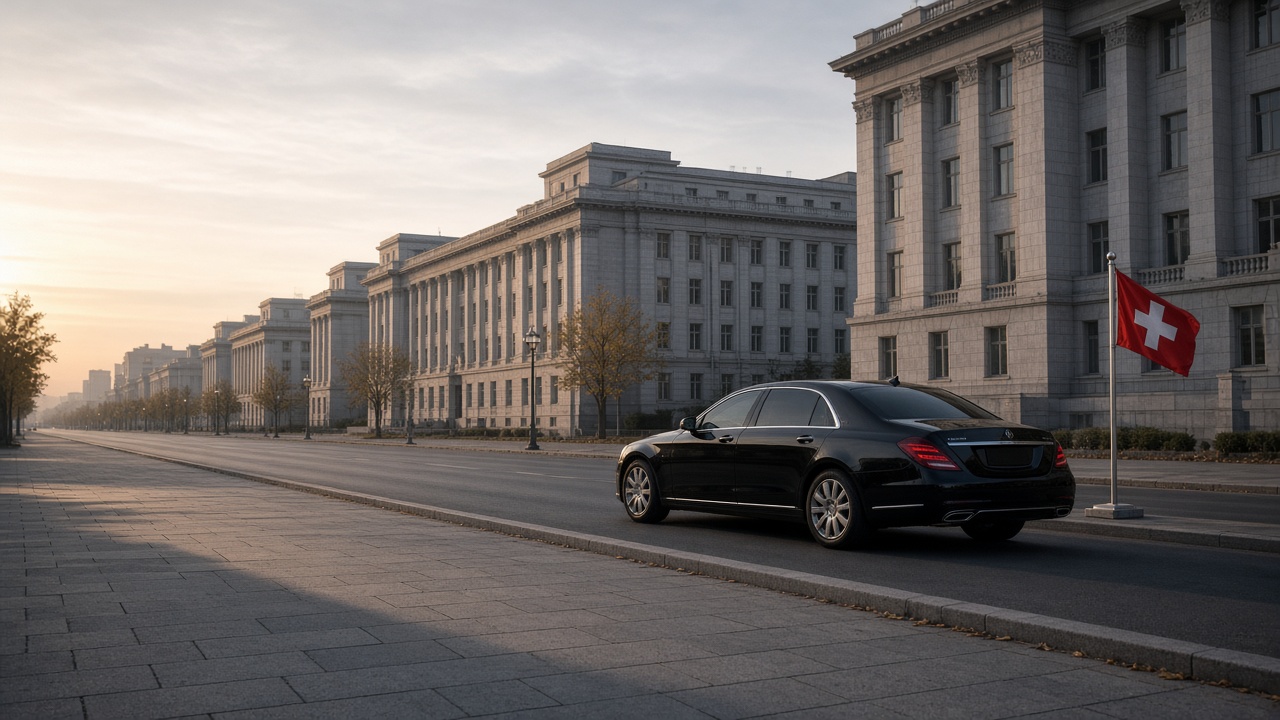
BERN. Foreign Minister Ignazio Cassis flies to Pyongyang on Thursday for the first visit by a member of the Federal Council to North Korea in more than twenty years. He will formally open Switzerland’s diplomatic office on Friday, 30 October, and hold political talks. He then continues to Seoul. A meeting with Kim Jong Un has not been announced.
The foreign ministry says the conversations will cover security on the Korean peninsula, the resumption of consultations between the two foreign ministries, and wider geopolitical questions. The office itself is already working. It opened on 19 October and reports to the Swiss embassy in Beijing, which keeps formal charge of diplomatic and consular relations with North Korea. Unlike the old development office, this one has a diplomatic mandate.
A presence withdrawn in 2020
Switzerland has not been a stranger in Pyongyang. A cooperation office of the development agency was there from 1997 until staff were pulled out in 2020, during the pandemic. What is new is the rank of the visitor and the job of the office. The last federal councillor to make the trip was Micheline Calmy-Rey, then foreign minister, in 2003.
Bern is also one of the few Western governments that has kept a political channel open while others have closed theirs. The European Union has essentially frozen direct dialogue with Pyongyang. Switzerland, by contrast, has spent recent years trying to reopen it. Swiss officers have watched the armistice on the inner-Korean border since the end of the Korean War, a presence that long predates this week’s flight and gives Bern a practical reason to be in the room.
Dialogue without a change in sanctions
The trip is not a softening of policy on paper. The foreign ministry has been explicit that no easing of sanctions is attached to the visit. Switzerland continues to apply the United Nations sanctions on North Korea. The offer, such as it is, is a conversation and a permanent desk, not a concession.
That is the Swiss method in miniature, and it is why the journey will be read in more than one way. Supporters of an active neutrality will call it good offices: a small state keeping a line open where larger ones will not. Critics will ask what is discussed in a capital under sweeping sanctions, and what Switzerland gets back besides the photograph. The ministry’s answer, for now, is the agenda itself. Peninsula security, a restarted consultation calendar, and a stop in Seoul so the trip is not only a visit to one side.
Cassis is in Pyongyang on Thursday and Friday, then in South Korea for talks with the government there. Nothing on the programme promises a breakthrough. The measurable change is smaller and, for a diplomacy that works by staying present, more characteristic. A Swiss office is open again in Pyongyang, under the embassy in Beijing, and a federal councillor is walking through the door for the first time since 2003.