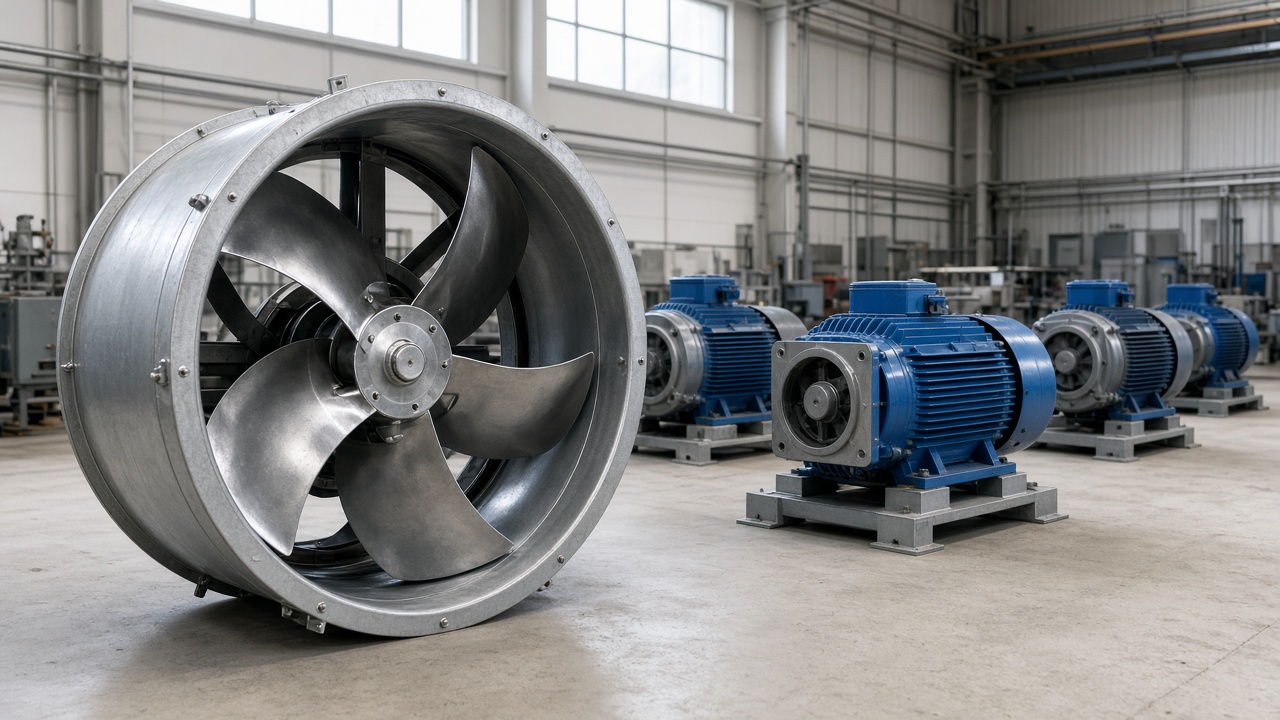
ZURICH. ABB has signed an agreement to buy Ziehl-Abegg, the German maker of high-efficiency fans and electric motors, for an enterprise value of 2.65 billion US dollars. The Zurich engineering group announced the deal on Monday. The equity value is 2.22 billion dollars, about 2 billion euros on the wire-service conversion. Closing is aimed at the second half of 2027, if regulators agree and the other customary conditions are met. ABB shares were indicated about 1.1 per cent higher before the Swiss open.
Ziehl-Abegg, based in Künzelsau in Baden-Württemberg, makes electronically commutated fans, integrated motors, ventilation systems and controls. ABB wants them beside its existing motors and drives, in the Motion business, so that a customer buying a cooling system can take the fan and the drive from one group. The release names the markets: heating, ventilation and air conditioning, industrial cooling, and thermal management. The products also go into data centres, clean rooms, medical equipment, factories, agriculture and lift drives. Ziehl-Abegg expects about 1.4 billion dollars of revenue in 2026, with an operational EBITA margin in the mid-single digits. ABB says that margin should sit broadly in line with the Motion average within three years of closing.
The price, and the time ABB is buying
On 2026 figures the deal is 1.9 times enterprise value to sales, and 18.6 times enterprise value to EBITDA. ABB says the EBITDA multiple should fall towards the low double digits once mid-term synergies and a better operating performance are counted. It also says the return on invested capital should sit well above the group's cost of capital. Those are the buyer's targets, not a result. A multiple of 18.6 is a full price for a business still earning a mid-single-digit margin, which is why the three-year margin promise is the sentence investors will test. In October ABB agreed a separate joint venture with Mitsubishi Electric in low-voltage equipment. Monday's purchase is a different product and a different country. It is the same habit: adding the piece next to the motor.
The company employs about 6,300 people, the count ABB gives for September 2026, across Europe, the Americas and Asia. ABB says it will keep the headquarters in Künzelsau and work with the existing management. Germany is already the group's third-largest market by revenue, with about 8,300 ABB employees at 35 sites. SWR, the south-west German broadcaster, reported that sale talks became public after the death of the industrialist Uwe Ziehl in June 2026, and that his children, Dennis and Sindia Ziehl, then held the family shares. A regional headquarters that stays put is a promise about a town. It is not, by itself, a promise about every job in a 6,300-person company.
The tape the deal arrived on
The AWP morning briefing put the wider market in context. The SMI closed Friday at 14,572 points, down 1.02 per cent, after printing a record at 15,272 earlier in the week and then giving up about 700 points as technology shares fell. The Nasdaq Composite lost 5.28 per cent on Friday, to 22,618, after the first trading session in Anthropic turned from celebration to a selloff. The Nikkei was shut for a holiday. Gold was up 2.65 per cent at 3,626.27 dollars an ounce. Brent crude was a little easier, near 92 dollars. The euro bought 0.9222 francs at 08:40, against 0.9201 on Friday evening. The SMI itself was indicated 0.09 per cent higher, at 14,585. A 1 per cent pop in ABB is a deal reaction inside a market that is trying to stand up after a technology shock, not a verdict on the 2027 closing.
Between signature and completion sit competition authorities and the ordinary conditions of a cross-border purchase. Nothing in Monday's release transfers the shares today. What it does transfer is a public number: 2.65 billion dollars for a fan maker whose machines sit in the cooling systems data centres and factories cannot run without. ABB's case is that the fan was the missing component. The margin target is the test of whether 18.6 times EBITDA was a price for that component or a price for a hope.