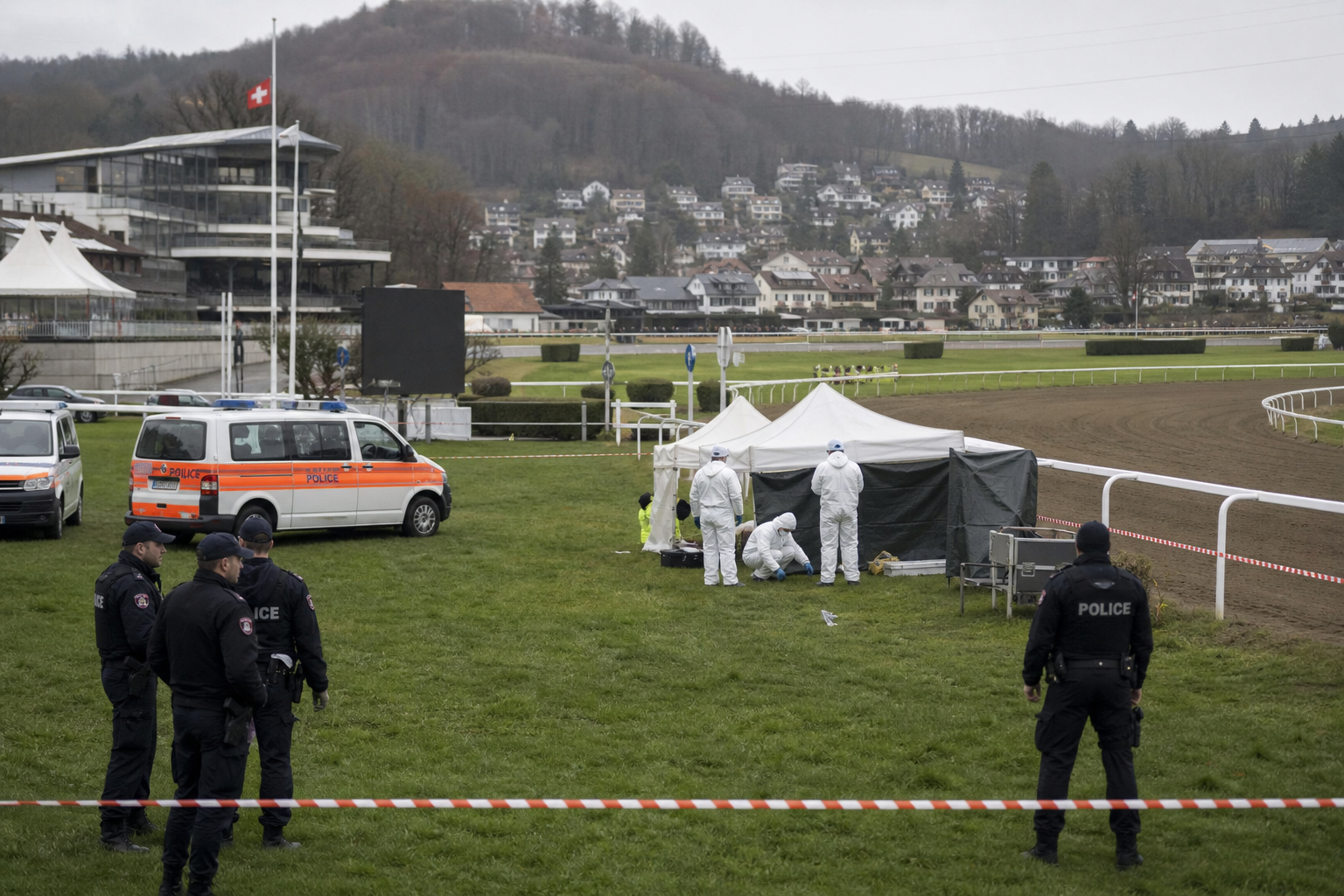
AARAU. The manhunt that began in the early hours of Sunday ran through the night and into a second day on Monday, as Aargau cantonal police acknowledged they still do not know who opened fire at the Aarauer Rave, or why. What they have established is who suffered. The woman who died at the Schachen racetrack was a 22 year old Italian citizen resident in Switzerland, and two more of the five wounded are Italian nationals.
Giorgia Meloni confirmed the Italian connection on Sunday evening, naming the dead woman in a statement and offering her government’s support to the families. Rome is following the investigation through its consulate, and Italian officials have been in contact with the Aargau authorities.
The forensic picture is becoming clearer. Casings recovered at the scene came from at least two weapons, a pistol and an assault rifle, a finding that points either to a single attacker carrying two firearms or to more than one shooter. Police have ruled out neither. The five injured, a German citizen and four Swiss men aged between 24 and 31, were taken to hospitals with wounds ranging from minor to severe.
The motive remains the open question at the centre of the case. Investigators are working on three scenarios: a terrorist attack, a rampage, or a settling of scores in the criminal milieu. Cantonal police commander Michael Leupold said on Sunday evening that none of the three could be excluded, and none yet had more evidence behind it than the others. The fact that the rave was already winding down when the shots came, a spokesperson added, argues against a classic attack on the crowd.
The scale of the operation is the largest Aargau has mounted in years. Virtually the entire cantonal force was deployed in the first hours, joined by units from neighbouring cantons, the Argus special operations unit, the cantonal disaster response team and an army Super Puma helicopter. More than a hundred attendees were taken to a gymnasium and questioned through the morning.
German federal police in Freiburg joined the search on Sunday, watching the motorway corridors and rail lines north. Armed officers were seen on motorways up to 30 kilometres from the Schachen. By Sunday evening the working assumption in Aarau was that the perpetrators had left the town, and possibly the country.
Witnesses described confusion in the first seconds. Several told the newspaper Blick they mistook the shots for fireworks until someone shouted for everyone to get down. The shooting came as the event, billed by its organisers as the canton’s largest one-day gathering of its kind, was winding down towards its scheduled close.
Police renewed their appeal on Monday for videos and photographs from the event and set up an upload channel alongside the helpline for relatives. The cordon around the racetrack, the swimming pool and the sports grounds remains in place while forensic teams work the site in daylight.
For a country with some of the most tightly registered gun ownership in Europe, the casings at the Schachen pose their own question. An assault rifle of the type suggested by the ammunition is not easily obtained outside military and licensed channels, and tracing its history will run through registries in several cantons.
The dead woman’s name had not been formally released on Monday morning, out of consideration for her relatives in Italy. What Aarau already knows is simpler and harder. A party of close to 3,000 young people ended with one dead and five in hospital, and the person or people responsible spent a second night somewhere the police have not yet looked.